 By iw
By iw 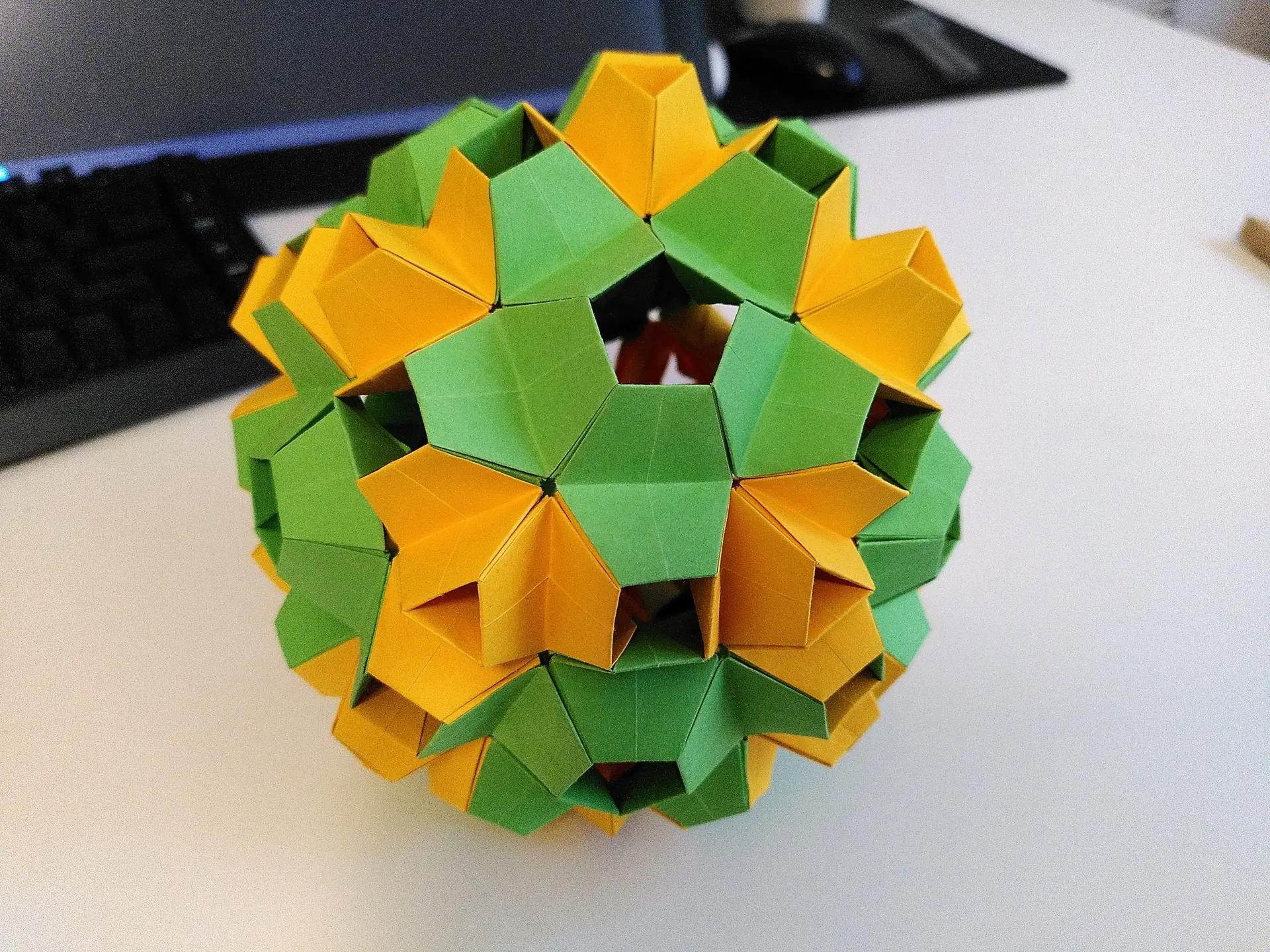
Designed by: Tomoko Fuse
Origami is more than just folding paper—it’s about transforming a flat sheet into a work of art through patience, skill, and a deep connection with the design. Today, I’m excited to share my latest creation: a Rhombicosipolyhedron Modular Origami piece made from 120 individual sheets of paper. This geometric wonder was inspired by the modular origami techniques pioneered by the renowned Japanese artist, Tomoko Fuse. Her approach to modular origami is legendary in the community, and this project is a testament to her design genius.
In this post, I’ll walk you through the process, offer tips on handling such a complex structure, and share the deeper meaning behind modular origami. Whether you’re an experienced folder or just starting out, there’s something here for everyone!
What is a Rhombicosipolyhedron?
For those new to geometric origami, a Rhombicosipolyhedron is a polyhedron that combines squares and triangles in a highly symmetrical structure. It’s not your average origami crane or flower, but rather a more mathematical and engineering-like design. The beauty of modular origami is that it takes many small folded units (in this case, 120 sheets) and assembles them together to form a stunning, three-dimensional structure without the need for glue or tape.
This particular shape is a mix of 30 square faces, 20 triangular faces, and 60 vertices—each one meticulously crafted to fit perfectly. The complexity lies not just in folding each unit but also in assembling the whole structure seamlessly.
Why Tomoko Fuse’s Modular Designs are So Popular
Tomoko Fuse is one of the most respected names in the world of modular origami. She has authored numerous books and has been a source of inspiration for both beginners and experts. What sets her designs apart is their elegance, precision, and the sense of calm they evoke despite their complexity.
Modular origami is like solving a puzzle. Each folded unit may seem simple, but putting them together to form a cohesive structure requires thought, planning, and patience. Fuse’s designs often explore geometric shapes, and they challenge the folder to think about how smaller units interact to form a larger whole.
For this project, I followed her instructions for constructing a Rhombicosipolyhedron, adjusting slightly to match my paper sizes and color scheme. Fuse’s clear guidance in her books makes even the most challenging designs feel achievable.
The Process: Folding and Assembling 120 Sheets of Paper
Completing this project required both mental and physical stamina. Below is the step-by-step process I followed, along with tips for success:
1. Selecting the Right Paper
Choosing the right type of paper is crucial for modular origami. Since this project involves 120 sheets, it’s essential to pick paper that’s durable yet foldable. I opted for7.5 cm x 7.5 cm sheets of drawing paper in a variety of colors to give the final piece a vibrant, kaleidoscopic look. I recommend using slightly thicker origami paper to ensure the structure holds firm once assembled.
2. Folding the Units
Each unit must be folded precisely to ensure that it fits perfectly with the others. The basic fold for each piece is relatively simple: a square sheet is folded into triangular sections. While the folding itself isn’t too difficult, repeating the process 120 times requires patience.
Tip: As you fold, pay extra attention to creases. Sharp, clean folds make the assembly process much smoother and result in a more polished final product.
3. Assembling the Structure
This is where things get tricky. Modular origami relies on interlocking the folded units to form a sturdy 3D shape. For the Rhombicosipolyhedron, I followed Tomoko Fuse’s detailed assembly process, connecting groups of five units at each vertex to form the distinctive polyhedral structure.
Tip: It’s easy to get overwhelmed when you’re deep in the assembly process, especially when handling large numbers of units. I recommend assembling smaller sub-sections first, then connecting them into the larger structure. This method helped me maintain symmetry and balance as I built the model.
4. The Final Touches
Once all the pieces were in place, I carefully adjusted the final structure, ensuring all units were snug and secure. This step is crucial, as loose connections can cause the entire piece to collapse.
Why I Love Modular Origami
Modular origami offers a unique combination of creativity, mathematics, and patience. Each folded unit represents a small step toward a much bigger goal, and there’s something incredibly satisfying about watching the individual pieces come together to form something so complex. It’s both a mental challenge and a meditative process—one that I would recommend to anyone looking to take their origami skills to the next level.
For this project, I felt a deep sense of accomplishment after completing the Rhombicosipolyhedron. It’s not just about the final product, but also the journey of folding, assembling, and refining as you go.
Final Thoughts and Advice
If you’re thinking of tackling a modular origami project like this, here are a few final pieces of advice:
- Take your time. Rushing through will only lead to mistakes. Enjoy the process and work at your own pace.
- Stay organized. When working with so many sheets of paper, keeping everything in order will save you a lot of frustration.
- Experiment with color. The geometric design of the Rhombicosipolyhedron looks even more striking when you use contrasting or complementary colors for different sections.
If you’ve tried this project or something similar, I’d love to hear about your experiences. Share your thoughts and questions in the comments below!
Thank you for reading, and happy folding!